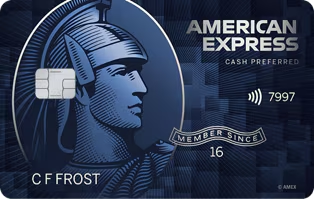
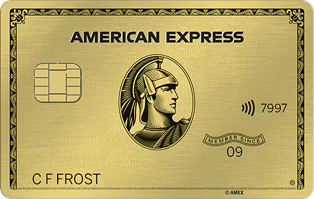
The Amex Blue Cash Preferred and the Amex Gold Card are both excellent Amex cards for people who spend heavily on food — but they're fundamentally different products aimed at different goals. The Blue Cash Preferred maximizes straightforward cash back on everyday household expenses: groceries, gas, streaming, and transit. The Gold Card maximizes flexible travel points that can fund business class flights and luxury hotel nights.
The right choice comes down to one question: do you want to save money on your monthly bills, or build points for future travel experiences?
Side-by-Side: The Key Numbers
| Feature | Blue Cash Preferred® | Amex Gold Card® |
|---|
| Annual Fee | $0 yr 1 then $95/yr ✓ | $325/yr |
| U.S. Supermarkets | 6% (up to $8,000/yr, then 1%) ✓ | 4x points (up to $25,000/yr) |
| Dining Rate | 1% worldwide | 4x worldwide — no cap ✓ |
| Gas Stations | 3% U.S. gas stations ✓ | 1x |
| Streaming Services | 6% select U.S. streaming ✓ | 1x |
| Transit (rideshare, buses, etc.) | 3% ✓ | 1x |
| Flights | 1% | 3x direct/Amex Travel ✓ |
| Everything else | 1% | 1x |
| Welcome Offer | Up to $300 cash back after $3,000/6 mo | Up to 100,000 pts after $8,000/6 mo ✓ |
| Annual Credits | $120 Disney Bundle credit | $120 dining + $120 Uber + $84 Dunkin' + $100 Resy = $424+ ✓ |
| Reward Type | Cash back (Reward Dollars) | Membership Rewards — 20+ transfer partners ✓ |
| Foreign Transaction Fee | 2.7% ⚠️ | None ✓ |
| Grocery Cap | $8,000/yr (then 1%) | $25,000/yr (then 1x) ✓ |
The Grocery Rate Math — Which Card Actually Earns More?
The headline rates look similar — 6% vs. 4x — but they're in different currencies (cash back vs. Membership Rewards points) that have different values. Here's the honest comparison:
Blue Cash Preferred
Category / Annual Spend
Amex Gold
Groceries ($500/mo × 12)
$360 cash (6%)
$360–$720 pts (4x at 1–2¢)
Dining ($400/mo × 12)
$48 cash (1%)
$288–$576 pts (4x at 1–2¢)
Streaming ($50/mo × 12)
$36 cash (6%)
$7.20 pts (1x)
Gas ($150/mo × 12)
$54 cash (3%)
$21.60 pts (1x)
$120 Disney Bundle credit
+$120
—
Annual fee
−$95
−$325
Net annual value (yr 2+)
$523 cash back
$352–$998 (at 1–2¢/pt)
The Blue Cash Preferred wins on raw cash value for typical households. The Gold Card can overtake it if you transfer points to airlines at 2¢+ per point — but that requires active redemption strategy, not just automatic deposits.
Round-by-Round Breakdown
Round 1: Grocery Earning
Depends on spending level
Blue Cash Preferred
6% on U.S. supermarkets, capped at $8,000/year (then 1%). If you spend $8,000/year in groceries ($500/month), you earn $360 in cash back — and then $360 covers the $95 annual fee plus $265 surplus. The cap is the key constraint. At $7,000+ annually in groceries, the Gold's uncapped 4x starts to compete.
Amex Gold
4x on U.S. supermarkets up to $25,000/year, then 1x. At 1.5¢/point (transfer value), that's 6% cash-equivalent — matching the BCP — but only if you actively transfer points rather than redeeming for statement credits at 0.6¢/pt. The Gold's 4x is genuinely better for heavy grocery spenders who invest in Membership Rewards transfers.
Round 2: Dining
Winner: Amex Gold (by a wide margin)
Blue Cash Preferred
1% on dining — essentially a non-category for restaurant spending. A household spending $400/month at restaurants earns $4.80/month in cash back. This is the Blue Cash Preferred's most significant gap: it's a grocery and household expenses card, not a dining card.
Amex Gold
4x on dining worldwide — no cap, no restrictions. Restaurants, takeout, delivery. At $400/month, the Gold earns $24–$48/month in equivalent value (at 1–2¢/point). Over a year, that's $288–$576 from dining alone — a category the BCP effectively ignores. This is the Gold's defining advantage for regular restaurant-goers.
Round 3: Gas, Streaming & Transit
Winner: Blue Cash Preferred
Blue Cash Preferred
3% at U.S. gas stations, 6% on select streaming subscriptions (Netflix, Hulu, Spotify, Disney+, ESPN+, and others), 3% on transit (rideshare, buses, trains, tolls, parking). For a commuter spending $150/month on gas and $50 on streaming: $5.40 + $3.00/month = $8.40/month from categories the Gold doesn't touch. Plus the $120 Disney Bundle statement credit offsets most of the annual fee.
Amex Gold
1x on gas, streaming, and transit. The Gold earns nothing meaningful on these categories — essentially treating them as everyday purchases. For drivers, streamers, and commuters, this is a meaningful gap. The Gold is designed around food spending and flights, not household utility spending.
Round 4: Travel Flexibility
Winner: Amex Gold
Blue Cash Preferred
Cash back earns as Reward Dollars — redeemable as statement credits only. No airline or hotel transfer partners. No elevated travel booking rate. For travel redemptions, BCP is a dead end. This is also a cash back card with a 2.7% foreign transaction fee, making it unsuitable for international use.
Amex Gold
Membership Rewards transfer to 20+ airline and hotel partners. Delta SkyMiles, Air France/KLM Flying Blue, ANA, British Airways, and others. At 1.5–2¢/point via transfers, the Gold's 4x grocery and dining rates effectively become 6–8% toward travel. No foreign transaction fee. 3x on flights. The Gold is a serious travel card disguised as a food card.
The Break-Even Point on Groceries
The fee difference between the Gold ($325) and BCP ($95) is $230/year. BCP earns 2% more on groceries (6% vs. 4% cash equivalent). To justify Gold over BCP on groceries alone, you'd need $230 ÷ 2% = $11,500 in annual grocery spending before the extra fee pays off — and that only works if you redeem Gold points at 1¢/pt. If you transfer Gold points to airlines at 2¢/pt, the break-even drops to $5,750/year. Run your own numbers based on how you actually redeem.
Our Verdict
Choose Blue Cash Preferred® if you...
- Primarily want cash back — not points that require transfer strategy
- Spend heavily on gas ($100+/month) and streaming subscriptions
- Want a $0 first-year annual fee to try before committing to $95
- Rarely dine at restaurants — dining is the BCP's most significant blind spot
- Travel internationally and don't want a foreign transaction fee card (get a no-fee travel card for that)
- Don't want to manage Membership Rewards transfers to airlines and hotels
Choose Amex Gold Card® if you...
- Dine out heavily ($300+/month) — 4x dining is unmatched at any annual fee
- Travel internationally and want no foreign transaction fees
- Want to build Membership Rewards points for airline or hotel transfers
- Spend $500+/month on groceries — the $25,000 cap vs. BCP's $8,000 matters
- Can capture the $424+ in annual credits (dining, Uber, Dunkin', Resy)
- Plan to pair with Amex Platinum later — Gold + Platinum is the optimal Amex food + travel combination
For most American households, the Blue Cash Preferred delivers more tangible value at a lower cost. Cash back is simpler, more immediate, and the 6% grocery + streaming + 3% gas combination covers the most universal household spending categories. The $95 fee (after the free first year) is easy to justify.
For people who eat out regularly and have any interest in travel, the Amex Gold's 4x dining is a genuine game-changer that no other card matches. The $325 fee looks steep until you calculate how quickly 4x on $600/month in restaurant spending accumulates to trip-funding points.
Blue Cash Preferred®
Up to $300 cash back · 6% groceries · 6% streaming · $0→$95/yr
Compare Grocery Cards →
† Terms apply. We may earn a commission.
Amex Gold Card®
Up to 100K pts · 4x dining + groceries · $424+ credits · $325/yr
Read Full Review →
† Terms apply. Welcome offers vary. We may earn a commission.
Frequently Asked Questions
Does Walmart count as a U.S. supermarket for either card?
Generally no. Walmart, Target, Costco, and other superstores are coded as discount stores or wholesale clubs, not supermarkets. Both the Blue Cash Preferred's 6% and the Gold's 4x supermarket rates typically do not apply to purchases at these stores. Kroger, Harris Teeter, Safeway, Whole Foods, and traditional grocery chains usually qualify.
Can you redeem Blue Cash Preferred rewards for travel?
No. Reward Dollars can only be redeemed as statement credits against your Amex bill. They cannot be transferred to airlines or hotels. For travel redemptions, the Amex Gold Card is the far superior choice.
Can I have both cards?
Yes. The Blue Cash Preferred and Amex Gold are in different card families (Blue Cash vs. Membership Rewards). Many cardholders hold both — using Gold for dining and travel, and BCP for groceries, gas, and streaming. The combined annual fee is $420 ($95 + $325), offset by $544+ in combined annual credits and the higher earn rates across all categories.
Which is better for international travel?
The Amex Gold Card, clearly. It has no foreign transaction fee and earns 3x on flights. The Blue Cash Preferred charges a 2.7% foreign transaction fee on all international purchases — essentially eliminating its cash back value when used abroad. If you travel internationally, use a different card.